The Capo Cheat Code
Every Key, Same Shapes You Already Know

Technique. Theory. Feel.
MY CAPO STORY
Somewhere along the way, the capo got a reputation as training wheels. Real players don’t need it, the thinking goes, they just learn the barre chords. That thinking is wrong, and it’s costing guitarists access to songs they’d otherwise avoid. A capo isn’t a workaround. It’s a transposition tool, and once you understand how it actually works, it opens every key on the neck using the four or five open shapes you already have under your fingers.
By the way, I will be adding a piece at the end of the week that utilizes the capo. Stay tuned.
Here’s the problem it solves. Most guitarists learn G, C, D, Em, and Am early, get comfortable, and stop there. Then a song shows up in Bb, Eb, F#, or Db, keys that look like a wall of barre chords, and the instinct is to skip the song, hunt for a “simplified” chart online, or grind through stiff full-barre voicings that sound thinner than the open-string versions. None of that is necessary. Move a capo to the right fret and every one of those “hard” keys becomes the exact shape you already play in G or D or A.
This issue covers the math behind that trick, a transposition chart you can reference in seconds, ten practical ways to use a capo beyond dodging barre chords, how three well-known guitarists actually use one, and a four-week plan to turn the chart into instinct instead of a lookup table.
Learning objectives
By the end of this lesson, you will be able to:
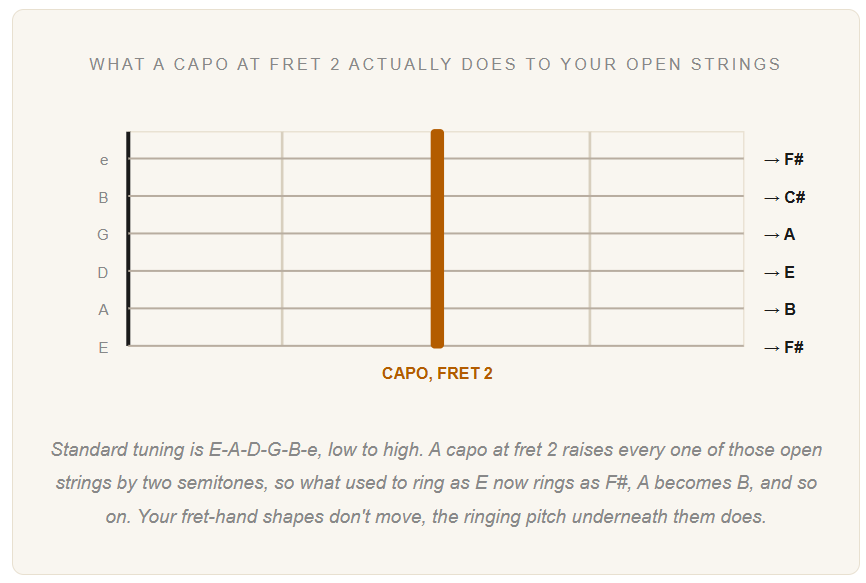
Explain exactly how a capo changes pitch, one fret equals one semitone, without changing the shape your fingers play
Read a capo transposition chart to find the right fret for any key in seconds, no mental math required
Apply at least 10 practical uses for a capo beyond avoiding barre chords
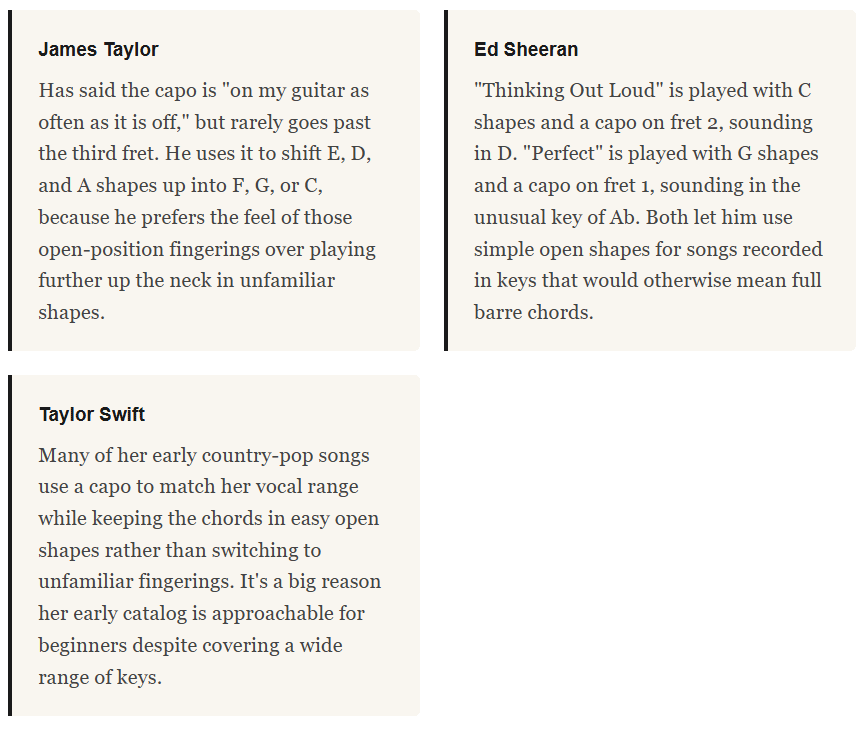
Recognize how James Taylor, Ed Sheeran, and Taylor Swift each use a capo differently and why
Run a 4-week routine that turns the transposition chart into instinct you carry to any song
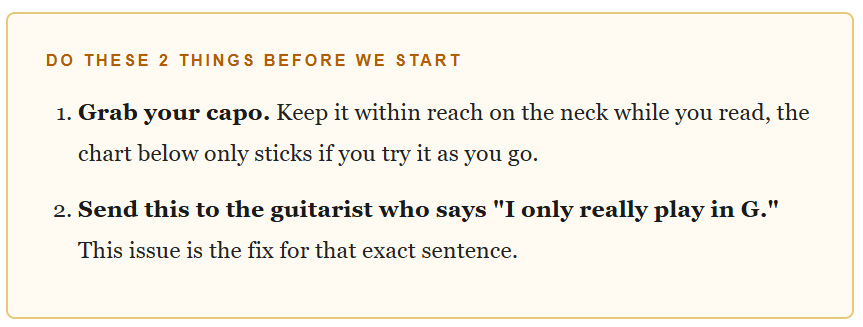
Good. Now let's get into it.
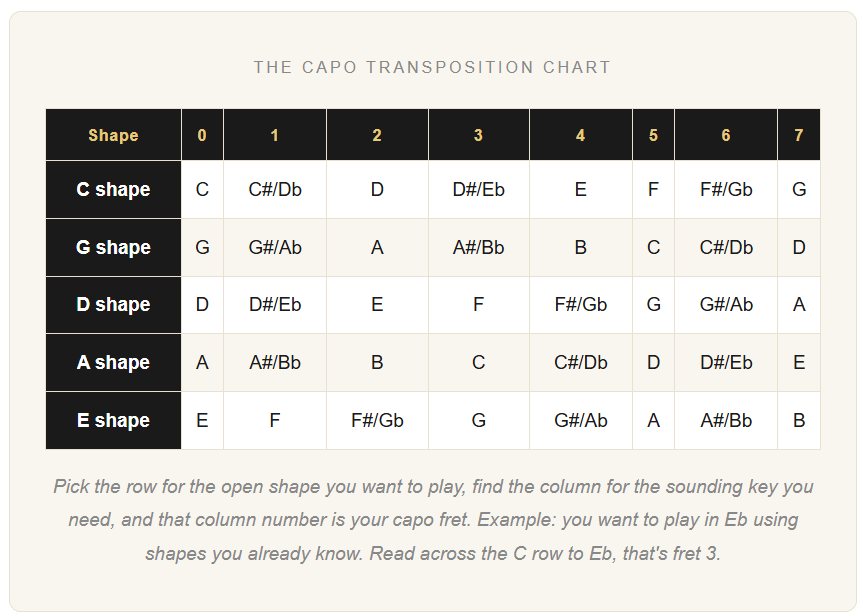
Every row in that chart is the same set of open-position fingers moved up the neck. Nothing about the shape changes. Your ring finger still lands where it always lands in a C chord. The capo does the work of raising the pitch, so your job is just picking which row you're most comfortable playing and matching it to the column you need.
ENJOYING THIS SO FAR?
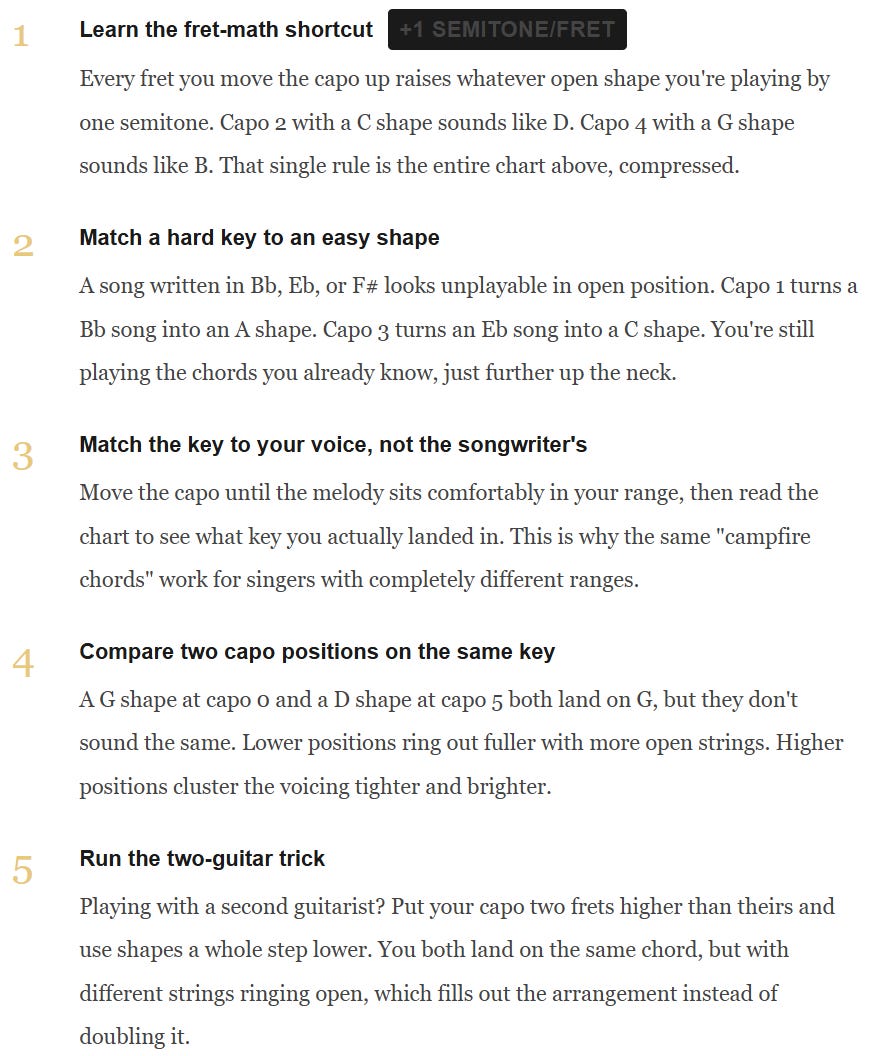
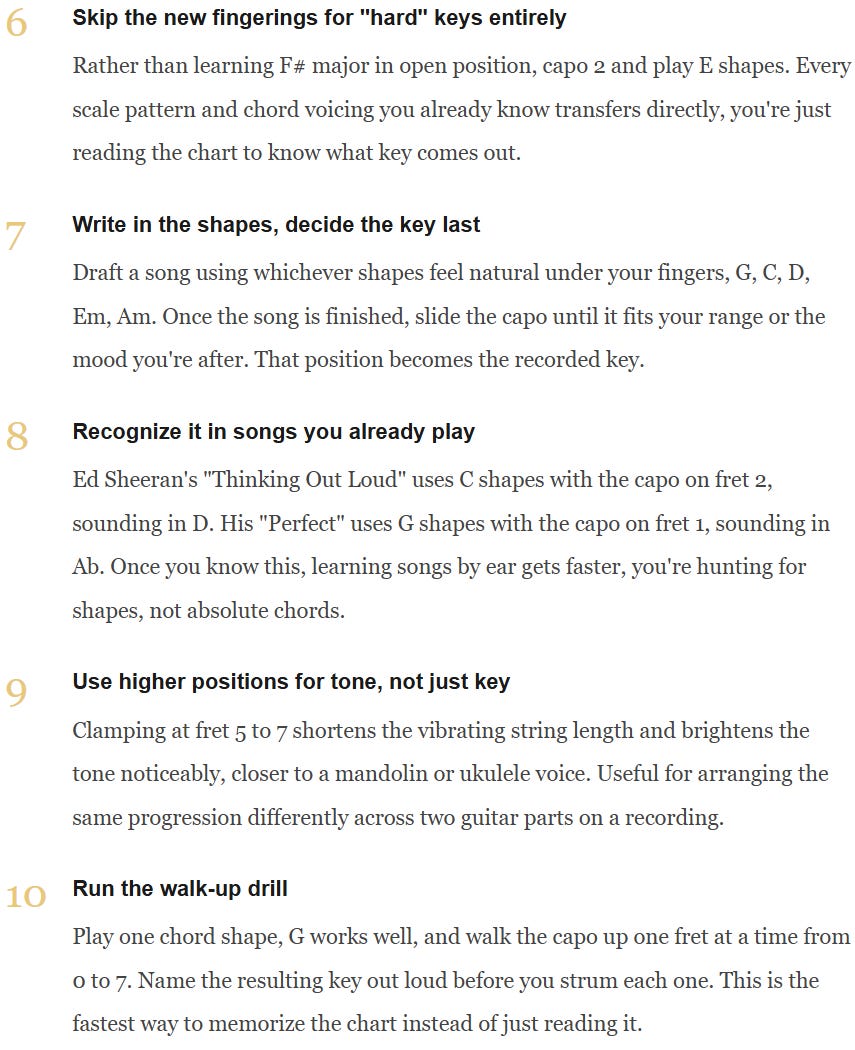
10 WAYS TO USE A CAPO BEYOND AVOIDING BARRE CHORDS
THIS ONE’S WORTH PASSING ON
HOW THE PROS USE THE CAPO
Three guitarists, three different reasons to reach for one. None of these are guesses, all three have talked publicly about how they use it.
SEND THIS TO ONE GUITARIST YOU KNOW
YOUR 4-WEEK CAPO KEY-EXPLORATION PLAN
The goal isn’t memorizing a chart. It’s getting to the point where you glance at a capo position and just know what key you’re in.
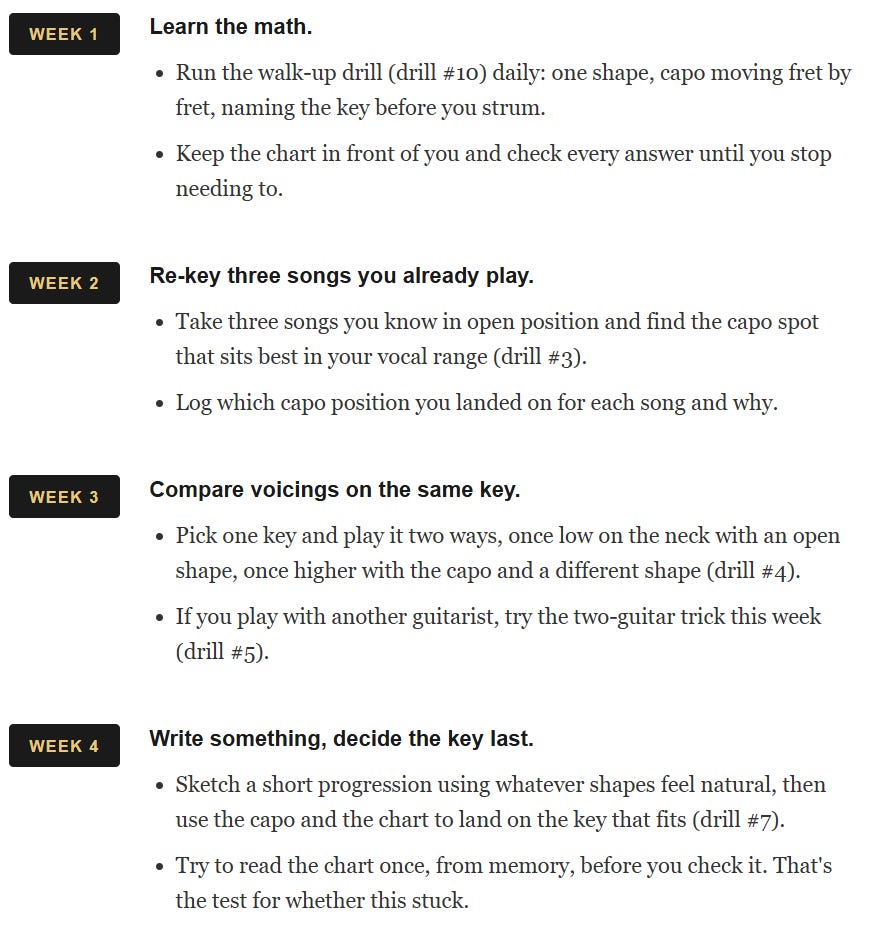
Every key is already under your fingers. The capo just tells you where to stand.
FROM THE ARCHIVE: READ THESE NEXT
You Walk In, Someone Hands You a Piece of Paper with Numbers on It. You Have 30 Seconds.
The Nashville Number System: the chart underneath the chart, and why the numbers never change even when the capo does.
You’re not getting a list of tips this month. You’re getting a system: four weeks of practice that build on each other, a way to check if it’s actually working, a place to point your creativity, and one idea about how this month on the guitar connects to the rest of your life.
Tuning Your Guitar & Maintenance
Setting up and maintaining a guitar is essential for ensuring it performs optimally and remains a joy to play. Proper setup can bring out the best tonal qualities of an instrument, make it more comfortable to play, and even prolong its life.