

The metronome taught me more about deadlines than any project manager
I bough my first real metronome out of embarrassment, not ambition.

A long long, very long time ago, I wanted to duet with another guitarist. My duet partner stopped us mid-phrase during a rehearsal, looked right at me, and said the tempo had crept up through the whole second variation, Variations on a Theme by Mozart. Nobody else in the room caught it. She did, because she’d spend that passage holding the bass line steady beneath me while I rushed the melody without noticing. That’s the memory. Not some tidy insight from a practice room. Just a guy stopping a song to call me.
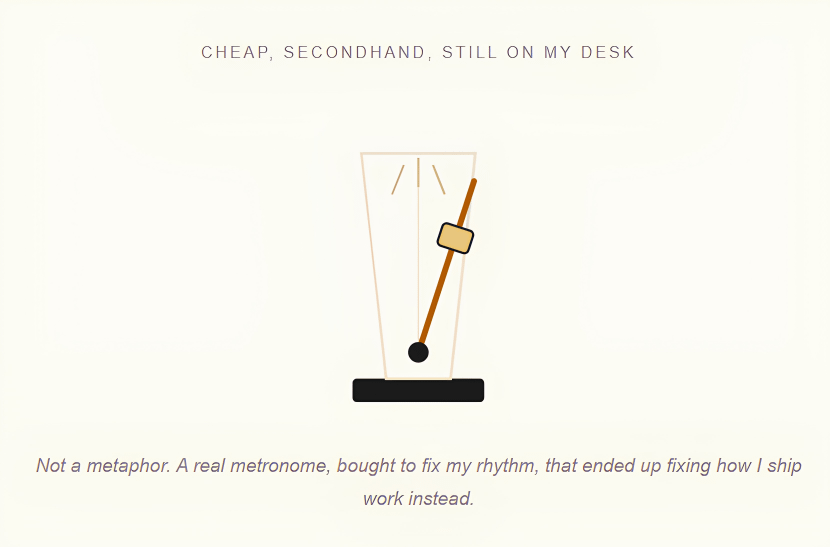
So I went and bought the cheapest metronome in the shop, mostly out of spite. It sat on my amp for two years before I respected it. Somewhere in there, without meaning to, I noticed it wasn’t rhythm the thing was training. It was honesty, whether I could keep a promise to a piece of music in real time instead of drifting and pretending I hadn’t.
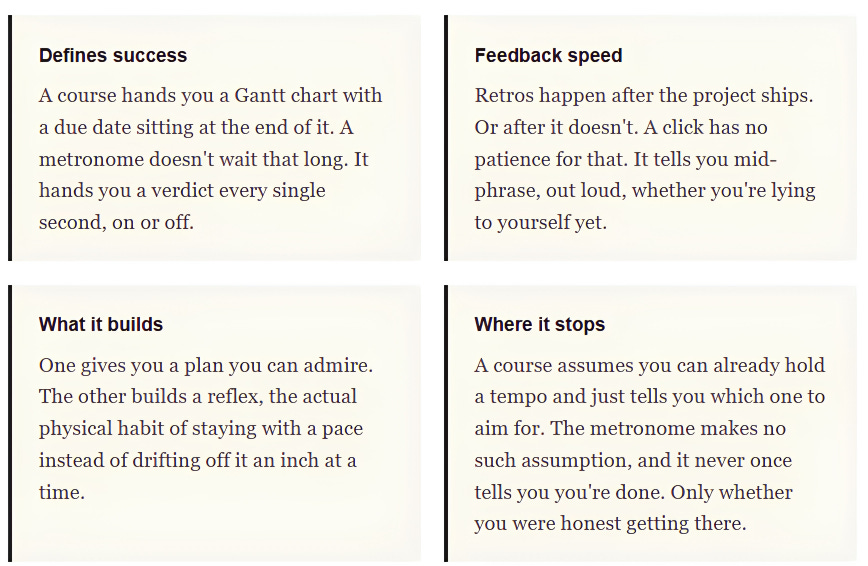
I’ve sat through the project management material too, or at least the version of it that shows up in every business newsletter: Gantt charts, sprint boards, the language for scheduling work you already know how to do. None of it did what the metronome did in month one. It never touched the actual gap, the one between committing to a date and physically holding still while the clock runs. Knowing something is due Friday and being able to sit inside that pressure without drifting are two different skills entirely. One’s calendar problem. The other lines somewhere lower down. The metronome only ever trained the second one. Which, it turns out, was the one I as missing.
WHAT YOU’LL WALK AWAY WITH
Why an external tick beats internal willpower for hitting deadlines, and how to build one into any project
The two-click method guitarsists use to add speed without falling apart, and how it maps onto compressing a timeline
What the actual project data says about why deadlines slip, and where the standard frameworks stop short
One checkpoint drill you can run on whatever you’re behind on this week
THE TICK DOESN’T NEGOTIATE
Straight metronome practice does something a to-do list never will. It takes bargaining off the table completely. Alone, at your own pace, it’s easy to ease off half a beat and tell yourself you didn’t. Try that against a click and you can’t get away with it. You hear the gap the second it opens, no interpretation required. A deadline we set for ourselves don’t though. We say “end of day” and quietly mean “end of day, unless something comes up, in which case we’ll see.” The metronome doesn’t understand unless. Neither does a closing date on a real estate deal, or a newsletter that’s scheduled to send whether the draft is ready or not. Somebody besides you is listening for the beat there. With a vague personal goal, you’re the only one holding the click, and you already know how that goes.
HOW TO BULT SPEED WITHOUT GUESSING
The actual technique is stupidly simple. You don’t jump from 60 bpm to120 because you feel ready, or because you’re annoyed at how slow 60 sounds after the tenth pass. You nudge the dials two clicks. Play it clean a few times. Nudge it two clicks again. Push it early and you don’t get faster, you just get sloppy at a higher number, which is worse than staying slow, because sloppy at speed feels like progress and isn’t. No productivity course I’ve ever read mentions this part. Speed is the leftover. The thing you get to keep once you’ve proven, at a slightly harder setting that the last one, that you can still do it right.
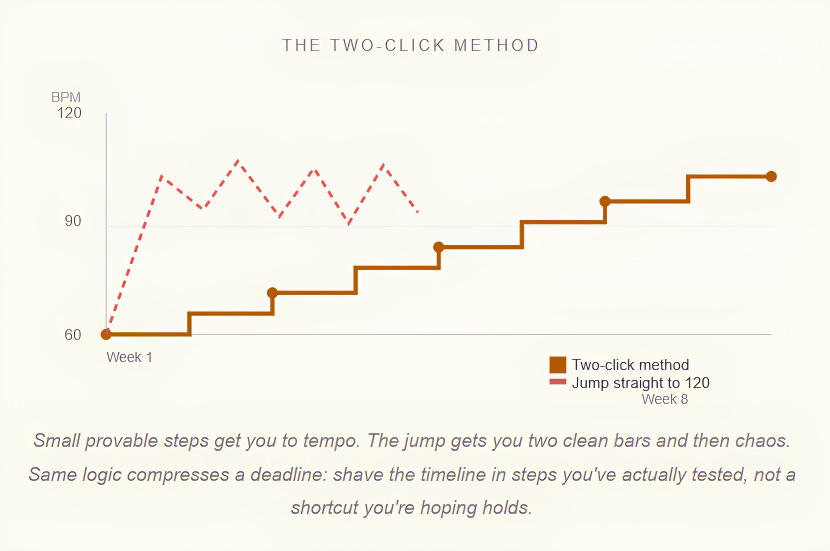
Do that with works and it looks a lot less impressive than it sounds. Instead of promising a client, or your own calendar, a deadline 40 percent shorter than your last one and hoping you grow into it, shave off 10, hit it clean twice, then shave another 10. Boring. also the only version of that sentence that’s actually true when you say it out loud. Most scheduling tools don’t make you do this part. They let you pick the date and assume the speed comes free with it. The metronome never let me get away with that.
STEAL THIS FOR WHATEVER YOU’RE BEHIND ON
Find the real subdivision. If it’s due Friday, give yourself a Wednesday checkpoint, the same way a metronome splits a beat into eighth notes so you can actually feel the space inside it.
Make the checkpoint binary. Wednesday, the work is at 90 percent. Built. Not “on track to be at 90 percent,” which is a sentence that means nothing.
Put the tick outside your own head. A calendar invite you can’t reschedule without someone noticing. A person expecting the update. Anything that catches it when you drift, because you won’t.
WHAT THE DATA ACTUALLY SAYS ABOUT MISSED DEADLINES
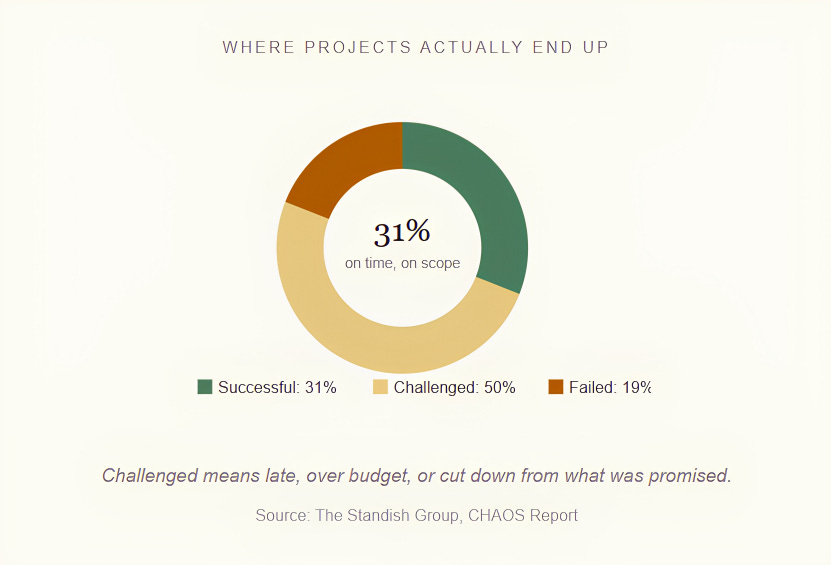
This isn’t just a guitar-room theory I’m stretching to fit. The Standish Group has tracked large software and IT projects for decades through its CHAOS research, and in its most recent published breakdown, only about 31 percent of projects came in successful: on time, on scope, no asterisk. Half landed in a bucket they call “challenged,” which is a polite word for late, over budget, or cut down from what got promised. Almost one in five got scrapped completely. PMI’s 2026 Pulse of the Profession report adds a meaner detail: 55 percent of complex projects that hit trouble missed their deadlines outright, not by a day or two, but as basically the deadline of the project. These are teams with certified project managers, scheduling software, and formal training already in place. The framework was never the missing piece. It was never going to be.
COURSE VS. CLICK
None of this is about turning rigid. Musicians who lock into a click for years end up looser, not stiffer, because the time underneath them is solid enough to push against on purpose. Same thing happens with deadlines, eventually. Prove to yourself, in small, boring provable steps, that you can hold a pace, and the dread around the due date just goes. Not all at once. But it goes. Mine started with a cheap metronome and a scale I genuinely could not play in time no matter how many times I ran it. I don’t know what yours starts with. Probably whatever you’re already behind on right now, if I had to bet.