


“Wonderwall” holds a strange record. It might be the most learned song in guitar history and the most banned from open mics, in the same breath. Every acoustic teacher has taught it. Every guitar shop clerk has begged a customer not to play it in the store. That reputation buries what’s actually happening in the arrangement: a capo trick, a chord voicing most players never learn on purpose, and a production job that came together in about a day.
Noel Gallagher wrote it on a capo, played nearly all the guitar on the record himself, and used a chord shape trick that keeps two strings ringing the same note through almost every change in the song. That’s not an accident. It’s a big part of why four open chords sound as big as they do.
This issue breaks the song down piece by piece: the technique that makes it work, the chart it was up against the week it came out, and a practice-ready chord chart so you can put your hands on it today.
Learning objectives
By the end of this issue, you will be able to:
Explain why the song is capoed at the 2nd fret and how that lines up with its key of F# minor
Identify the chord voicing trick that keeps the B and high e strings ringing through every change
Play the exact Em7, G, Dsus4, A7sus4, and Cadd9 shapes Gallagher used on the recording
Understand how overdubbed acoustic guitars and a Mellotron built the song’s full sound
Place the song in its chart moment: what it was up against in the UK the week it was released
The Song, In Brief
Noel Gallagher wrote “Wonderwall” and recorded it with the rest of Oasis in May 1995 at Rockfield Studios in Monmouth, Wales, for the album (What’s the Story) Morning Glory? Owen Morris produced the track alongside Gallagher, and by most accounts the whole thing, guide vocal to final mix, came together in about a day. Creation Records released it on October 30, 1995 as the album’s fourth single. It peaked at #2 on the UK Singles Chart and reached #8 on the US Billboard Hot 100. The song sits at 87 BPM in 4/4, in the key of F# minor, though nobody in the band actually plays an F#m shape to get there.
5 Skills Hiding Inside One Riff
1 | Capo Transposition (Fret 2)
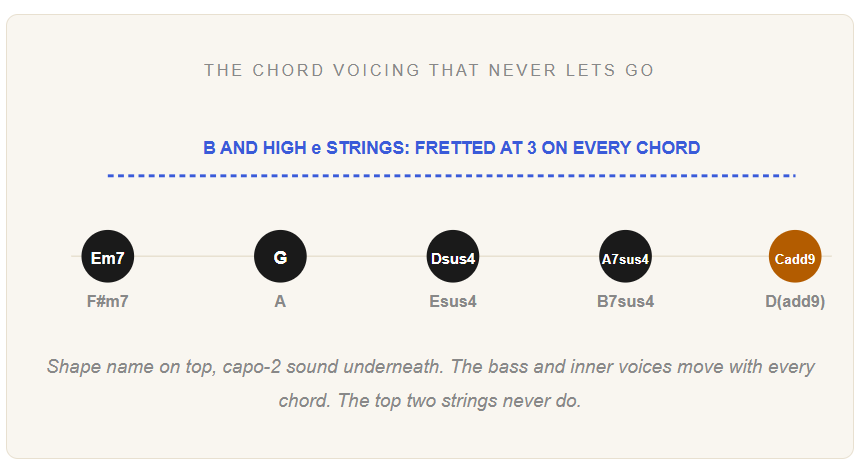
Gallagher capoed at the 2nd fret and played open-position shapes: Em7, G, Dsus4, A7sus4, and Cadd9. With the capo on, those shapes sound as F#m7, A, Esus4, B7sus4, and D(add9), which lines up with the song’s actual key of F# minor. Playing open shapes instead of barre chords in that key is what keeps the strumming loose and the open strings ringing.
2 | The Pedal-Tone Voicing
Look closer at the fingerings and something stands out: the B and high e strings sit fretted at the 3rd fret on every chord in the progression, Em7 through Cadd9. Most open chords let those top strings ring open or shift with the chord. Here they stay locked in place while the bass notes move underneath. That constant high pair gives the song its ringing, almost bell-like top end, and it’s a voicing trick worth stealing for your own progressions.
3 | Suspended Chords (Dsus4, A7sus4)
A sus chord swaps the third for a fourth, so it lands as neither major nor minor. It wants to resolve, and doesn’t, not right away. Gallagher leans on Dsus4 and A7sus4 through the verse instead of resolving cleanly to D or A, which is why the progression feels like it’s floating instead of landing. Hold the tension a beat longer than expected: that’s the whole trick.
4 | The Connecting Riff
Between vocal lines, there’s a short hammer-on and pull-off figure on the high e string, a quick move up and back down that fills the gap where a singer would otherwise leave dead air. It’s two notes, not a solo, but it’s what separates someone who learned the chords from someone who learned the song.
5 | Multi-Tracked Acoustic Layering
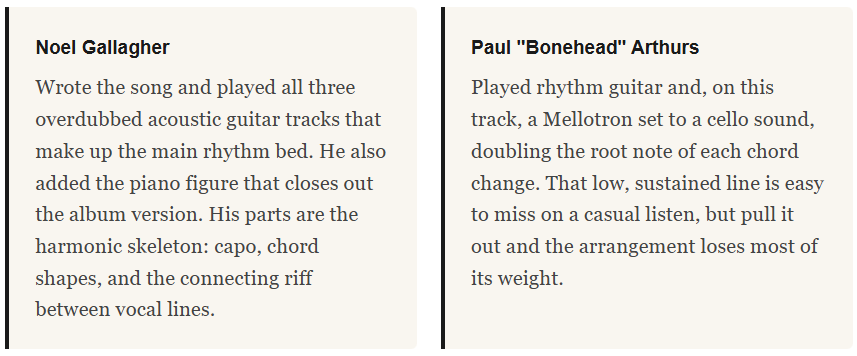
Gallagher didn’t play this once and call it finished. He overdubbed three separate acoustic guitar parts on top of each other. Rhythm guitarist Paul “Bonehead” Arthurs added a cello line on a Mellotron, doubling the root of each chord, and Kurzweil strings went on during the mix. Producer Owen Morris compressed the whole thing hard, a technique he called brickwalling, to make a handful of overdubbed acoustic guitars sound like an orchestra. None of it requires more than a guitar, a second take, and a willingness to record yourself twice.
This one's worth passing on
Noel vs. Bonehead: Two Different Jobs
The record works because the two guitarists never do the same thing at the same time. Gallagher built the structure, layer by layer. Arthurs filled in the low end nobody notices until it’s gone.
What It Was Up Against
“Wonderwall” went out as a single on October 30, 1995. Here is the UK Singles Chart top 5 for the chart week closest to that release, dated November 5, 1995. Notice who was sitting at #1.
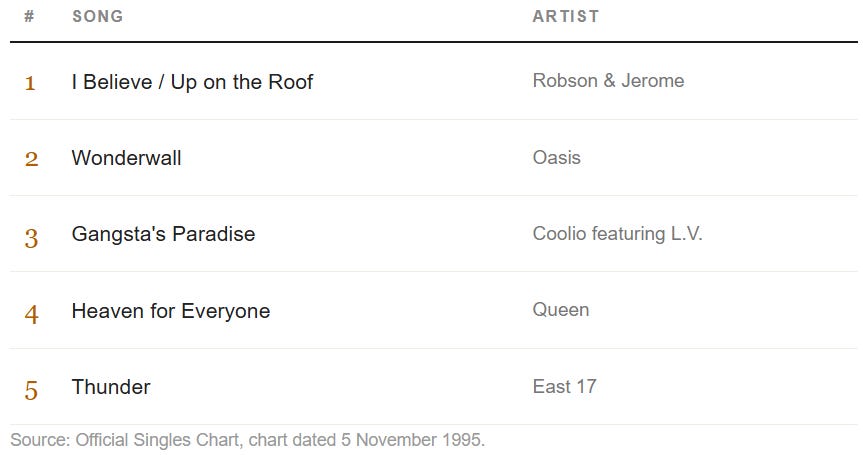
“Wonderwall” peaked at #2 on the UK chart and never reached #1, kept off the top spot by Robson & Jerome’s double A-side. In the US, the song took longer to build, eventually reaching #8 on the Billboard Hot 100 in early 1996.
Sheet Music: Chord Shapes and Tab
Everything below is capoed at the 2nd fret, tuned standard (EADGBE). Play the shapes listed and they sound as the chords in parentheses. These are the real voicings behind the song, the ones most transcriptions agree on. A full note-for-note reproduction of the studio recording, including all three of Gallagher’s overdubbed guitar parts, requires a licensed transcription (Hal Leonard publishes an authorized version), so treat the chart below as a practice arrangement built on the real chord shapes, not a copy of the studio take.
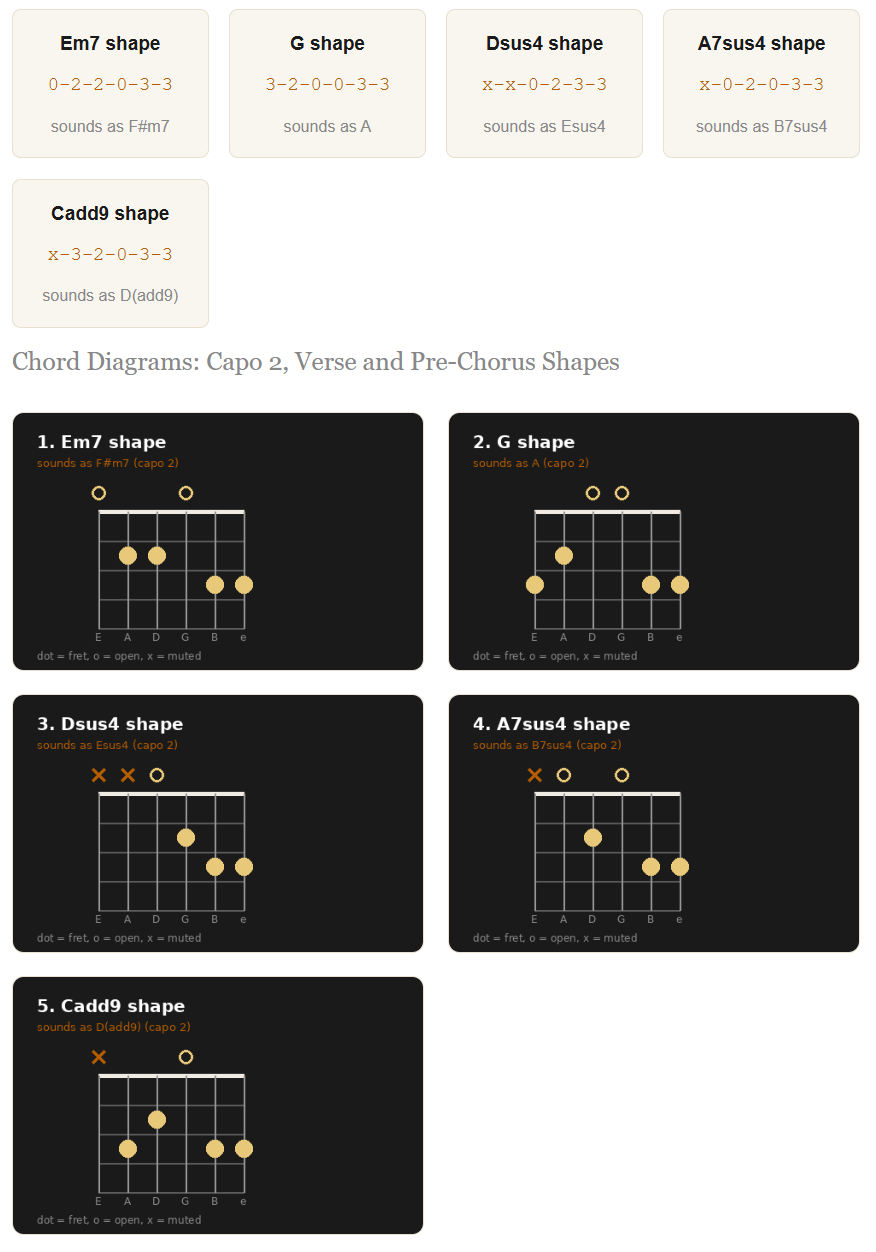
Strum in steady eighth notes, down and up throughout, and don't rush the move from Dsus4 to A7sus4. That's where most beginners clip the sus sound short. Loop the four-chord verse cycle, Em7, G, Dsus4, A7sus4, until your fretting hand can move between shapes without looking, then add Cadd9 for the pre-chorus. The hard part isn't any single chord. It's keeping the B and high e strings from buzzing while your other fingers move underneath them.