

You know four chords. You've only ever played one shape of each
Inversions turn C-Am-F-G into twelve different voicings, using nothing you don't already know.

Know a player who'd love this? Forward it.
This Week’s Focus
Inversions: The Same Four Chords, Twelve Different Voicings
Play C, then Am, then F, then G, all in the position you learned them in year one, and you’ll hear the problem before you can name it. The chords are correct. The progression is also flat. Your hand jumps around the neck, the bass note lands somewhere different every single time with no logic connecting one to the next, and after sixteen bars the ear checks out even though nothing was played wrong.
Every major or minor triad has exactly three positions: root in the bass, the third in the bass, or the fifth in the bass. Same three notes, different note on bottom. Guitarists call the second two “inversions,” and they’re written as slash chords: C/E means play a C chord with E as the lowest note. Nothing about the chord changes. What changes is which note anchors it, and that single choice is where most of the variety in a progression actually lives. Take a plain four-chord progression like C-Am-F-G. Each chord has three positions. That’s twelve distinct voicings sitting inside a progression most players only ever play one way.
This issue covers the three positions of one chord, how to read and write slash-chord notation, a documented real-song example built entirely on inversions, ten practical ways to use them, and how Jimmy Page, John Mayer, and Chet Atkins each lean on the same idea differently.
Learning objectives
By the end of this lesson, you will be able to:
Name and locate the three positions, root, first inversion, second inversion, of any major or minor triad
Read and write slash-chord notation (C/E, G/B, D/F#) without stopping to think
Build a moving bass line under a progression using inversions instead of new chords
Explain how the “Stairway to Heaven” intro uses inversions to create its descending bass line
Apply at least 10 practical uses of inversions to progressions you already play
This is one issue. GuitarMomo sends a new technique breakdown like it every week.
Now let's get into it.
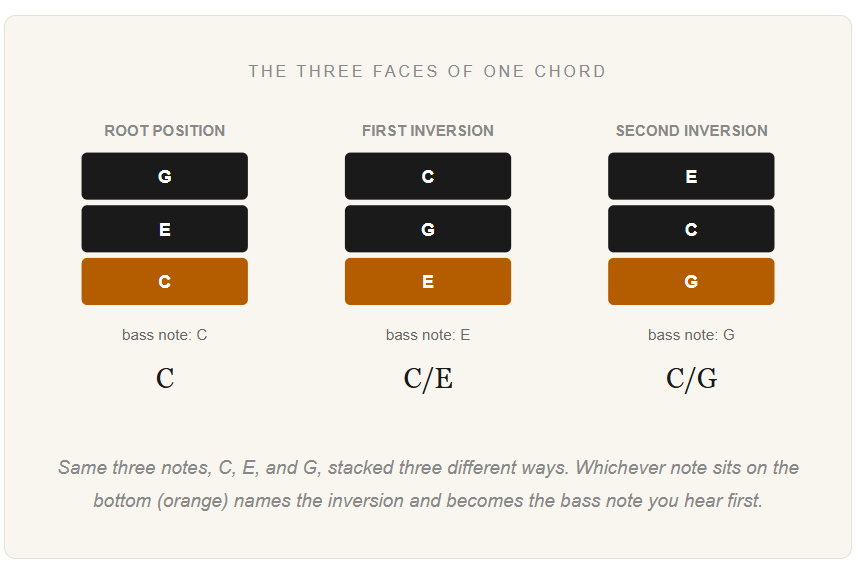
Slash-chord notation just describes that bottom note. The letter before the slash is the chord. The letter after the slash is what's in the bass. C/E is a C major chord with E on bottom, which is first inversion by definition, since the third of a C chord is E. C/G is second inversion, the fifth in the bass. Second inversion tends to sound the least settled of the three, since a fifth in the bass is a shakier foundation than a root or a third, so most players save it for passing motion rather than parking on it.
📚 Related skill - Slash chords are how session players chart this stuff live. If you've never read a Nashville Number chart, The Nashville Number System covers the exact shorthand a player would use to write "G/B" fast enough to play it cold.
